Getting a Saudi visa from Pakistan is not hard. Picking the wrong visa type is where most people lose time and money.
Most applicants travel for one of four reasons: work, family, business or Umrah. Each route has its own documents, its own cost and its own timeline. This guide covers all of them, plus the full UAE side, in plain words. You will see real fee ranges in rupees, step by step processes, the documents officers actually ask for, and how to check your visa status yourself on official portals.
Short on time? Start with the quick answer below. This guide comes from ProNexa, a visa consultancy that processes Saudi and UAE cases for Pakistani clients every week, and every step below follows the same process our own case managers use. Ready to apply? Request a free visa estimate and let a case manager review your route before you spend anything.
A Saudi visa from Pakistan always starts with a sponsor or an approved route. For work, a Saudi employer hires you and applies for your visa authorization through MOFA, then you complete a Wafid medical, document attestation and Tasheer biometrics in Pakistan. The full process usually takes 2 to 8 weeks, and your personal cost is typically PKR 70,000 to PKR 150,000 because the employer pays the official visa fee.
Visa Types for Saudi Arabia and the UAE: Which One Do You Need?
Saudi Arabia and the UAE issue separate visas for work, family, business, tourism and Umrah. Your purpose decides the visa, and the visa decides your documents and cost. The table below compares every main option side by side.
| Visa | Best for | Stay or validity | Entry |
| Saudi Work Visa | People with a Saudi job offer | Tied to your contract, Iqama after arrival | Single entry, converts to Iqama |
| Saudi Business Visit Visa | Meetings, trade, company visits | 30 to 90 days per visit | Single or multiple |
| Saudi Family Visit Visa | Visiting close family in Saudi Arabia | 90 days, extendable | Single or multiple |
| Saudi Family Residence Visa | Living with family in Saudi Arabia | Long term, renewed with Iqama | Residence permit |
| Saudi Tourist or Visit Visa | Tourism and events | 30 days | Single entry for Pakistani applicants |
| Umrah Visa | Umrah pilgrimage | Up to 90 days | Single entry |
| UAE Visit Visa | Tourism, family and business trips | 30, 60 or 90 days | Single or multiple |
| UAE Work and Residence Visas | Job holders, investors, freelancers | 2 years standard, 5 or 10 years for Green and Golden | Residence permit |
Saudi Work Visa
This is the most searched route, and it works one way only. A Saudi employer sponsors you, and you cannot apply for it alone. Section 2 below covers the full process step by step.
Saudi Business and Commercial Visit Visa
Saudi companies invite you for meetings, deals, training or after sales work. The Saudi company starts the invitation on its side, and MOFA approves it before you apply in Pakistan. You cannot do a job on this visa.
Saudi Family Visit Visa
An Iqama holder in Saudi Arabia invites close family members, such as a spouse, parents or children. The sponsor applies online first. Your family then completes the submission at a Tasheer center in Pakistan.
Saudi Family Residence Visa
This visa lets your spouse and children live with you in Saudi Arabia long term. Your profession and salary decide whether you qualify. Section 4 explains both family options in detail.
Saudi Tourist and Visit Visa
Pakistan is not on Saudi Arabia’s eVisa list, so you arrange this visa before you travel. Section 5 covers the current rules, including the 30 day single entry change.
Umrah Visa
You get an Umrah visa through a licensed Umrah operator or the Nusuk platform. It covers Umrah and travel inside Saudi Arabia, but it never allows work.
UAE Visit Visa
You apply through an airline, a hotel, a UAE based sponsor or a licensed travel agency. Options run from 30 to 90 days, single or multiple entry. Section 9 lists current prices in rupees.
UAE Work and Residence Visas
Employers sponsor standard work visas for 2 years. Skilled workers, freelancers and investors can also qualify for the self sponsored Green Visa (5 years) or Golden Visa (10 years).
Setting up a company instead of taking a job? Start with a business setup in Saudi Arabia if the Kingdom is your market, because owning a company changes which visas you and your staff can use.
Saudi Work Visa from Pakistan: The Full Process, Step by Step
A Saudi work visa from Pakistan follows one fixed chain. Your employer starts the process inside Saudi Arabia, and you complete your part in Pakistan. The chain has eight steps, and rushing any one of them is what delays most cases.
Who Is Eligible for a Saudi Work Visa?
You are eligible if a Saudi employer hires you and you fall inside the general age limit of 21 to 60 years. Most employers prefer candidates between 22 and 45, especially for labor and technical trades. You also need a valid job offer before anything else can start.
Two rules cause the most confusion. First, there is no direct application. Without a sponsor, there is no work visa. Second, you cannot work legally on a visit or tourist visa. People who try it risk fines, jail and deportation.
No job offer yet? Licensed recruitment channels list verified Saudi demand through corporate manpower services. Never pay anyone who promises a work visa without an employer behind it.
Documents You Will Need
Keep these ready before your employer even applies. Small mismatches here cause big delays later.
- Passport valid for at least 6 months, with 2 blank pages
- CNIC copy
- Recent photographs that match Saudi specifications (white background)
- Signed job offer or contract copy
- Degrees or diplomas, if your profession needs them
- Experience letters that match your job title
- Police clearance certificate
One detail matters more than people think. Your name must read exactly the same on your passport, CNIC and application. A single spelling difference can stop the file.
Steps 1 and 2: Job Offer and MOFA Visa Authorization
Your employer applies to the Saudi Ministry of Foreign Affairs (MOFA) for a work visa authorization. Large companies usually hold block visas against an approved demand. Smaller employers apply case by case.
MOFA issues a visa authorization number for your name and passport. Your employer or agent then uses E-Wakala, the electronic authorization system, to assign your case to the Saudi embassy or an approved agency in Pakistan.
Ask your employer for this authorization number and keep it safe. You will need it at the medical center, at Tasheer and when you check your status online.
Step 3: Wafid Medical Test
Book your medical at a Wafid approved center. Wafid (formerly GAMCA) runs the medical program for Gulf countries, and you can book through the Wafid website. The exam covers blood tests, a chest X-ray and a physical check for infectious diseases.
Your result uploads straight into the system. A “Fit” result lets your file move forward. An “Unfit” result stops it, and Section 8 explains what you can do in that case.
Step 4: Document Attestation and Trade Test
Professions that need qualifications get their documents attested in a chain. The Higher Education Commission (HEC) attests your degree first. The Ministry of Foreign Affairs in Pakistan attests it next. The Saudi Embassy or Saudi Cultural Mission completes the chain.
Skilled trades often need a trade test as well. Electricians, plumbers, AC technicians and similar workers may sit a practical test through NAVTTC or the Saudi Takamol skill verification program. Your employer confirms whether your profession needs it.
Step 5: Tasheer Biometrics and Visa Stamping
You submit your passport and documents at a Tasheer visa service center. Tasheer runs six centers in Pakistan: Islamabad, Karachi, Lahore, Multan, Peshawar and Quetta. Staff take your fingerprints and scan your documents at the appointment.
Saudi Arabia no longer pastes a visa sticker in Pakistani passports. You receive an e-visa printout with a QR code instead. Carry that printout when you fly.
Step 6: Protector of Emigrants
Every Pakistani worker needs Protector clearance from the Bureau of Emigration and Overseas Employment (BEOE) before flying out. You register through the e-Protector system, pay the official charges and get the Protector stamp on your passport.
Do not skip this step or try to fly without it. Airport immigration checks for it, and the clearance also activates your emigrant insurance and welfare fund coverage.
Steps 7 and 8: Travel and Your Iqama
Your visa gives you a window, usually 90 days, to enter Saudi Arabia. Your employer receives you on arrival, and passport control (Jawazat) assigns you a border number. Keep that number. It links to your file until your Iqama exists.
Your employer then completes your medical insurance and issues your Iqama through Muqeem, normally inside the first 90 days. The Iqama is your residence and work permit in one card. Carry a copy at all times.
How Long the Whole Process Takes
| Stage | Typical time |
| MOFA authorization (employer side) | 1 to 2 weeks |
| Wafid medical | 2 to 4 days |
| Attestation, if needed | 3 to 10 days |
| Tasheer submission and decision | 5 to 10 working days |
| Protector clearance | 1 to 3 days |
| Total | 2 to 8 weeks |
Fast cases finish in about 2 weeks when the employer is ready and your documents are clean. Slow cases usually trace back to one problem: late authorization, an attestation gap or a medical retest.
Want this handled end to end? A ProNexa case manager tracks every stage and flags problems early. Start with a free visa estimate.
Saudi Visa Price in Pakistan: The Full Fee Breakdown
There is no single Saudi visa price in Pakistan, because the law splits the bill. Your employer pays the official work visa fee and the Iqama cost. You pay for the Pakistan side items: medical, attestation, Protector and any agency service charges. For most workers, the personal total lands between PKR 70,000 and PKR 150,000.
Work Visa Fees: Who Pays What
| Item | Paid by |
| MOFA work visa authorization and visa fee | Employer |
| Iqama and work permit (roughly SAR 6,000 to 7,200 per year) | Employer |
| Wafid medical test | Usually you, unless the contract says otherwise |
| Document attestation | You |
| Protector charges and insurance | You |
| Air ticket | Usually the employer, check your contract |
Saudi labor law puts recruitment costs on the employer. So learn this rule and use it. If an agent asks you to pay the visa fee into a personal bank account, walk away. That one request exposes most scams.
Saudi Work Visa Fees by Job Category
Your personal cost shifts with your trade, because skilled roles need more testing and paperwork.
| Job category | Typical personal cost (PKR) |
| Labour and general worker | 70,000 to 110,000 |
| Driver and security guard | 80,000 to 130,000 |
| Technician (AC, electrician, plumber) | 90,000 to 140,000 |
| Nurse and skilled medical staff | 120,000 to 180,000 |
These ranges cover your Pakistan side spending: medical, police certificate, attestation, Protector and normal processing charges. A quote far above your row needs a written explanation before you pay anything.
Visit and Family Visit Visa Fees
The government fee for a Saudi family visit visa is about SAR 300. Insurance and service center charges in Pakistan add to it. Most families pay PKR 40,000 to 65,000 in total through an agency, depending on the visa validity they choose.
Business and Tourist Visa Fees
Business visit visas vary with validity and entries. A 6 month or 1 year multiple entry visa costs more than a single entry one. Through agencies, business visit visas typically run PKR 60,000 to 85,000. A pre-arranged tourist visa usually costs PKR 35,000 to 55,000.
Umrah Visa Cost
The Umrah visa itself is a small part of an Umrah package. Hotels, flights and transport decide most of the price, and Ramadan packages cost the most. Compare full packages side by side instead of chasing the cheapest visa line.
Hidden Costs Most Agents Do Not Mention
Quotes often leave out small items that add up fast.
- A medical retest, if the center calls you back
- Attestation agent and courier charges
- Protector insurance premium
- Photo reprints that match the exact specification
- Travel to the Tasheer center city, if you live far away
- Exchange rate movement on items priced in riyals
Ask for an itemized quote in writing. A clean agent has no problem giving you one.
Saudi Family Visit Visa and Family Residence Visa
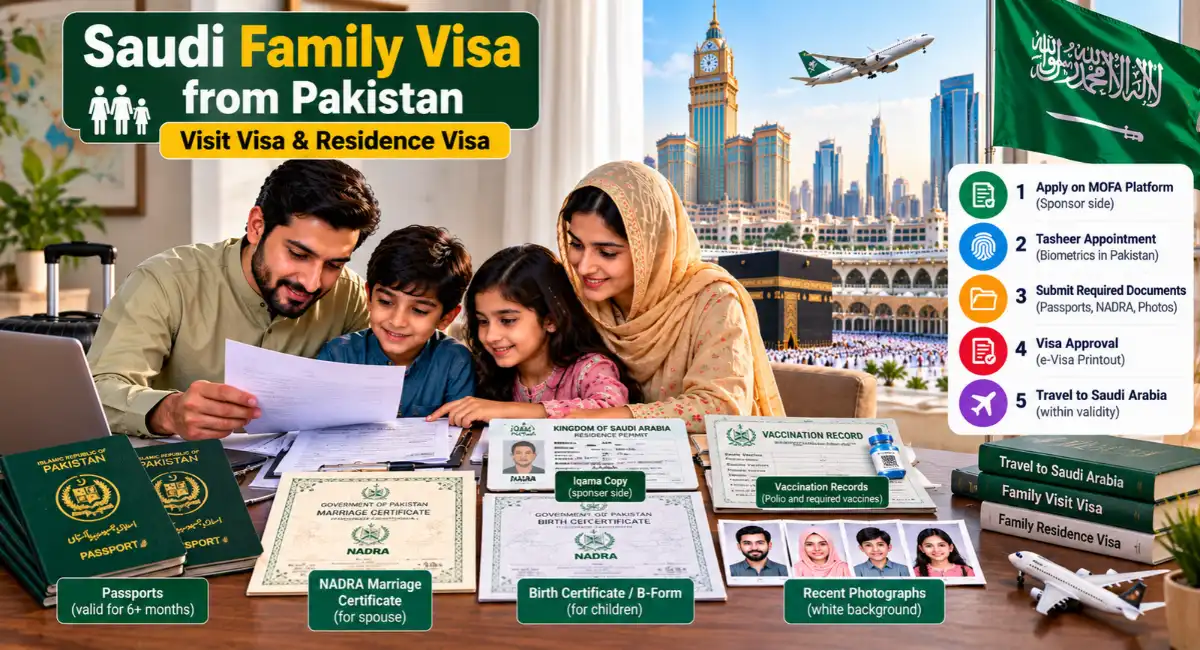
A family visit visa lets your close relatives visit you in Saudi Arabia for a limited stay. A family residence visa lets your spouse and children live with you there long term. Both start with you, the Iqama holder, applying from the Saudi side.
Family Visit Visa Process, Step by Step
- You apply for a family visit visa on the MOFA visa platform and get an approval document with an application number.
- You send that approval to your family in Pakistan.
- Your family books a Tasheer appointment and submits passports, photos and relationship documents.
- Tasheer takes biometrics and forwards the case for the visa decision.
- Your family receives the e-visa printout and can travel within the visa validity.
Most approvals come through in 1 to 3 weeks when the relationship documents are complete.
Documents Required for a Family Visit Visa
- Your Iqama copy and passport copy (sponsor side)
- Passports of each visitor, valid for 6 months or more
- NADRA marriage certificate for your spouse
- Birth certificates or B-Form for children
- Recent photographs with a white background
- Vaccination records where asked, including polio and routine childhood vaccines
Relationship proof is the heart of this application. MOFA wants NADRA issued documents, not handwritten nikah papers alone.
Family Residence Visa: Who Qualifies
You qualify when your profession and salary meet the conditions the Saudi authorities set for family sponsorship. Engineers, doctors, teachers, managers and similar professional categories usually qualify. Many manual labor categories do not.
The process runs through your employer and the Jawazat (the General Directorate of Passports). Once approved, your family enters on the residence visa and receives Iqamas after arrival, just like workers do.
Family Visit or Family Residence: Which Should You Choose?
| Point | Family visit visa | Family residence visa |
| Purpose | Short visits | Living together long term |
| Stay | 90 days per visit, extendable | Continuous, renewed with your Iqama |
| Work rights | None | None for dependents by default |
| Schooling and services | Limited | Full resident access |
| Who qualifies | Most Iqama holders | Profession and salary conditions apply |
Choose the visit visa for holidays and short stays. Choose residence when your family is moving to Saudi Arabia with you for real. If you hand the file to ProNexa, we check every NADRA paper against the passport names before submission, because a single mismatched spelling is the most common reason family cases stall.
Saudi Visit and Tourist Visa: What Pakistanis Must Know
Pakistani passport holders cannot use Saudi Arabia’s tourist eVisa, and they do not get a tourist visa on arrival in normal cases. You arrange your visit visa before you travel, through the proper channel for your trip’s purpose.
Can Pakistanis Get a Saudi Tourist eVisa?
No. Pakistan is not on the list of countries whose citizens can apply for the Saudi tourist eVisa online. Any website that offers you an instant Saudi eVisa for a Pakistani passport is misleading you.
The 30 Day Single Entry Rule
Saudi Arabia changed visit visa rules in February 2025. Visit visas for Pakistani nationals now come as single entry with a 30 day stay, instead of the older multiple entry pattern many families remember. Plan your trip inside that window, and do not assume an extension.
The Exception: US, UK and Schengen Visa Holders
One exception exists. If you hold a valid US, UK or Schengen visa that you have already used at least once, you may qualify for a Saudi visa on arrival. Airlines check this eligibility before boarding, so confirm with your airline first.
Visit Visa Requirements and Fees
You need a passport valid for 6 months, photographs, and a confirmed reason to travel, such as a family invitation or an approved tour arrangement. Fees follow the ranges in Section 3 above. Medical insurance comes bundled with the visa, as Saudi rules require it for visitors.
The Truth About the “Azad Visa”
In the market, “Azad” means this: a sponsor issues a work visa in his name, you pay him a lump sum, and then you work wherever you like and pay him a yearly fee. Agents present it as freedom. The paperwork tells a different story. Your Iqama names that sponsor, and Saudi law holds you to him.
Why the Azad Visa Is Illegal: The Real Risks
- You work for someone other than your sponsor, which breaks labor and residency law.
- Police checks can lead to arrest, fines and deportation, plus a ban on returning.
- Your sponsor can report you as absconding (huroob), and that report alone can wreck your status.
- Employers outside the system owe you nothing. Unpaid wages and no insurance are common stories.
- You have no safe legal route to complain, because your own arrangement breaks the rules.
Workers lose years of savings on this route. The cheap entry price is the trap, not the benefit.
Azad Visa Scam Red Flags
- The agent uses the words “Azad” or “free visa” as a selling point
- You must pay the full amount in advance, in cash
- The payment goes to a personal account, not a company
- There is no written contract and no receipt
- The agent cannot show you a visa authorization number
- The sponsor is “a Sheikh” whose name you will learn later
One red flag is enough to stop. Two means run.
Legal Alternatives to the Azad Visa
Take the normal work visa route in Section 2, where a real employer sponsors you and pays the official fees. If you want business freedom, look at a business visit visa for trips, or a proper investor and business setup route in Saudi Arabia or the UAE. Both keep you legal, insured and able to open bank accounts and sign contracts in your own name.
How to Check Your Saudi Visa Status Online
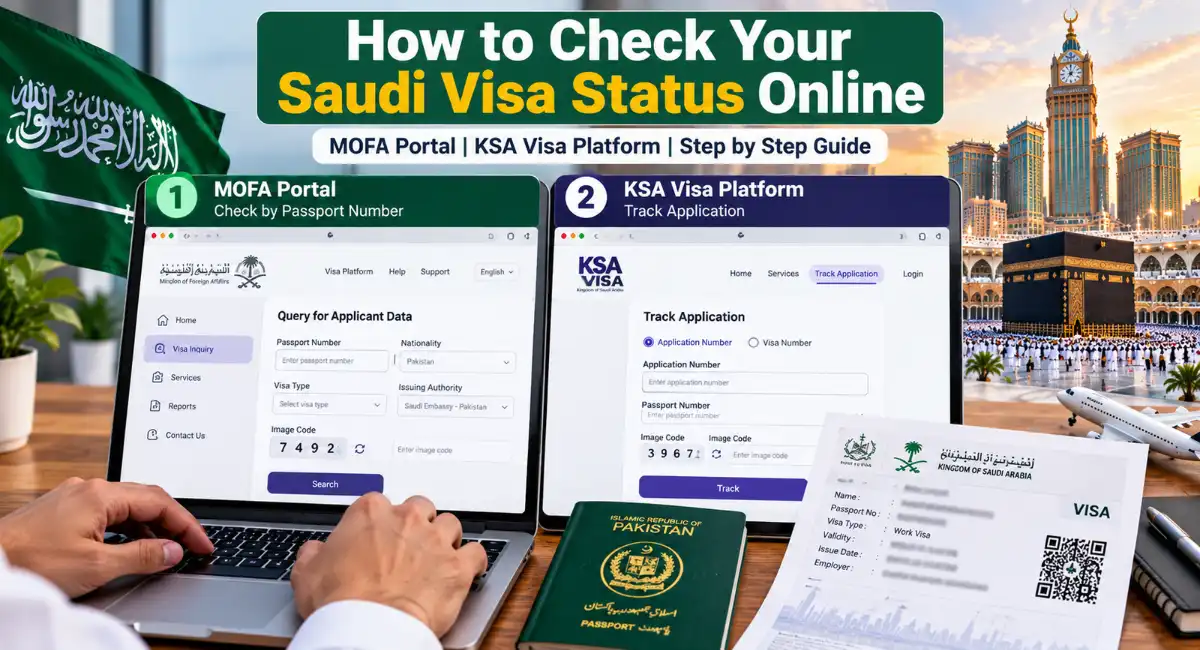
You can check your Saudi visa status yourself, free, on two official portals. Use the MOFA visa platform when you only have your passport number. Use the KSA Visa platform when you have an application number. Either check takes under two minutes.
Method 1: MOFA Portal, Check by Passport Number
- Open the MOFA visa platform.
- Choose the inquiry service for applicant data.
- Enter your passport number and select your nationality.
- Select your visa type and the issuing authority (the Saudi embassy or consulate for Pakistan).
- Enter the image code and search.
The result shows your application data and whether a visa has been issued against your passport.
Method 2: KSA Visa Platform, Track Application
- Open the KSA Visa platform.
- Choose Track Application.
- Enter your application number or visa number, plus your passport number.
- Complete the captcha and track.
This tracker also shows your medical certificate status, which makes it the better check for work visa applicants.
Check by E-Number, Enjaz Number, or Without an Application Number
Older applicants ask about Enjaz. The old Enjaz website no longer works. Its services moved into the MOFA platform and the KSA Visa platform, so ignore any site that still offers an “Enjaz check” and asks for your details.
No application number? Use Method 1 above. The MOFA search finds your record with your passport number, nationality, visa type and issuing authority alone.
How to Print Your E-Visa
Saudi visas for Pakistanis now come as printed e-visas with a QR code, not passport stickers. On the MOFA platform, open the Print Visa service. Enter two identifiers, such as your visa number and passport number, select your nationality and inquire. Print the visa on plain A4 paper and carry it with your passport.
How to Verify Your Visa Is Genuine
Run one of the checks above yourself, on the official portal, with your own passport number. A real visa appears there with your correct name, passport number, visa type and, for work visas, your employer. An agent’s PDF, screenshot or “checking link” proves nothing, because all three are easy to fake.
If your visa does not appear on the official portal, treat it as not issued, whatever the agent says. In Pakistan, you can also confirm that your recruiter appears on the BEOE list of licensed promoters, and you can report fraud to the FIA on 1991.
Domestic Worker Visa Check: Musaned
Domestic worker visas, such as house drivers and housemaids, run through Musaned, the Saudi domestic labor platform. The employer checks the status on Musaned with his ID and the request number. The worker’s own check still works on the KSA Visa tracker once a visa number exists.
Check Iqama and Exit Re-Entry Status on Muqeem and Absher
Already in Saudi Arabia? The Muqeem portal checks Iqama validity and exit re-entry visa status for residents. Absher, the government services platform, shows the same records for your own account. Employers use Muqeem for their workforce, and Jawazat offices handle anything the portals cannot fix.
“Visa Not Found”? Causes and Fixes
| What you see | What it usually means | What to do |
| No result found | Wrong visa type or issuing authority selected | Recheck each field and search again |
| Application not found | Your agent or employer has not submitted yet | Ask for the application number and proof of submission |
| Medical not passed | Your Wafid result is unfit or not linked | Check your result on Wafid with your passport number |
| Approved or issued | Your visa exists | Print your e-visa and confirm the details match your passport |
| Visa used | Someone already traveled on it | Contact the embassy and your sponsor at once |
Most “not found” cases are field mistakes, not lost applications. Check the passport number digit by digit before you panic.
Saudi Visa Rejected? Common Reasons and How to Fix Them
Most Saudi visa rejections from Pakistan come from five causes: an unfit medical, a name mismatch, missing attestation, a sponsor side problem, or an old overstay or ban. Each cause has a fix, and reapplying without fixing it just burns another fee.
Medical Rejection: Wafid “Unfit”
Wafid marks applicants unfit for conditions such as hepatitis B or C, HIV, active TB and certain other listed diseases. Some results come from a bad sample or a temporary illness. If you believe the result is wrong, ask the medical center about its review process and retest rules before you spend on a new application.
Name and Document Mismatch Errors
Your application name must match your passport exactly. Different spellings between your CNIC, passport and application are the most boring rejection reason, and the most common one. Fix the weakest document first, then reapply with one consistent spelling everywhere.
Incomplete or Wrong Attestation
Degrees attested by the wrong authority, or in the wrong order, stall professional visas. Follow the chain in Section 2: HEC, then the Ministry of Foreign Affairs, then the Saudi side. Photocopies of attested documents do not pass where originals are required.
Sponsor Side Problems
Sometimes the fault sits in Saudi Arabia, not in your file. Your employer’s Nitaqat rating (the Saudization system) may be too low, his block visa quota may be finished, or his authorization may have expired. Only your employer can fix these. Ask him directly for the current status of your authorization number.
Previous Overstay, Ban or Fake Documents
An old overstay, an absconding report or a past ban blocks new visas until the Saudi authorities clear it. Fake documents are the worst case. They can bring a permanent ban, and no agent can honestly promise to remove one.
Can You Reapply After a Rejection?
Yes, you can reapply once you fix the reason for the rejection. There is no magic waiting period for most categories. But government fees are not refunded, so a rushed second attempt costs real money. Get the rejection cause in writing, fix that exact point, and then file again.
Dubai and UAE Visa from Pakistan
Dubai visit visas are open for Pakistani nationals in 2026, and you apply through an airline, a hotel, a UAE resident sponsor or a licensed agency. Work visas work differently: only a UAE employer can sponsor one. This section covers prices, requirements, the work route and the long term Golden and Green visas.
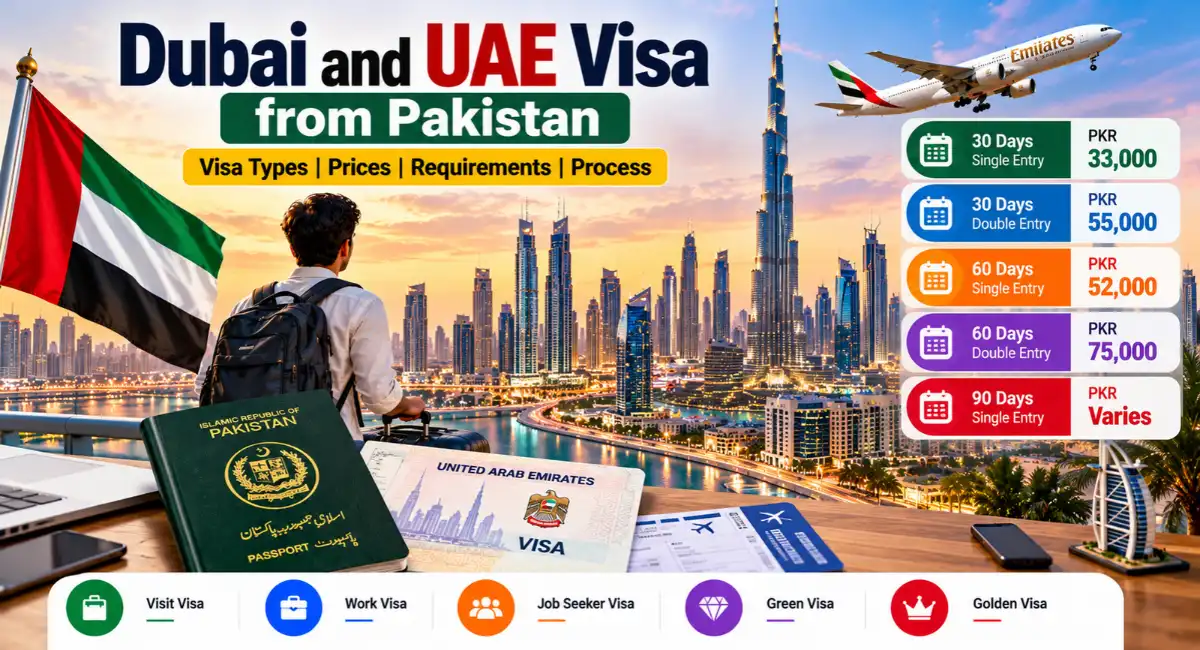
UAE Visit Visa Types and Prices in PKR
| Visa type | Typical price (PKR) |
| 30 day, single entry | About 33,000 |
| 30 day, double entry | About 55,000 |
| 60 day, single entry | About 52,000 |
| 60 day, double entry | About 75,000 |
| 90 day, single entry | Varies by agency, ask for a written quote |
Prices move with the dirham exchange rate and the season. Children often pay half the adult fee. Any price far below the table deserves a second look before you pay.
UAE Visit Visa Requirements
- Passport valid for at least 6 months from your arrival date
- CNIC copy, front and back
- Photograph with a white background
- Confirmed return ticket and hotel booking (your agency can arrange both)
- Bank statement for the last 6 months, stamped by your bank
- For applicants aged 18 and over, a copy of your last educational degree or certificate is now commonly requested as well
Apply inside the right window. Agencies accept applications from about 58 days before travel up to 5 working days before it. Earlier is safer, because corrections cost days.
Is the Dubai Visa Open for Pakistanis in 2026?
Yes. UAE visit visas are open for Pakistani nationals across tourist, family and business categories, and there is no blanket ban. Most visit visas arrive within 3 to 5 working days, and express handling can cut that to 24 to 48 hours at a higher fee.
Approval Reality: Age, Profile and Transit Visas
Approval is not equal for every profile, and honest agents say this upfront. Families and applicants aged 40 and above see strong approval rates. Single applicants under 40 get refused more often, especially with thin bank statements or no travel history. This is a pattern agents observe, not a published rule.
Two hard facts matter here. First, transit visas through Dubai are currently not processed for Pakistani nationals, so plan your connections with a proper visit visa or a single ticket. Second, Pakistani passport holders get no visa on arrival in the UAE. Arrange your visa before you fly, every time.
UAE Work Visa: The Employer Sponsored Process
A UAE company hires you first. The company then applies to MOHRE (the Ministry of Human Resources and Emiratisation) for your work permit and entry permit. You enter the UAE on that permit, complete a medical test and Emirates ID biometrics inside the country, and sign your labour contract. Your residence visa is usually valid for 2 years.
Never work on a visit visa while you “wait for conversion.” Working on a visit visa is illegal, and honest employers complete your permit before your first working day.
UAE Job Seeker Visa: What It Is and What It Is Not
The job seeker visa lets qualified people enter the UAE for 60, 90 or 120 days to find work, without a sponsor. It targets skilled professionals, graduates of top ranked universities and fresh graduates of recognized institutions. It gives you time to interview. It does not give you a job, and it does not let you work until an employer converts your status.
Golden Visa vs Green Visa
| Point | Golden Visa | Green Visa |
| Duration | 10 years | 5 years |
| Sponsorship | Self sponsored | Self sponsored |
| Main routes | Property or investment of AED 2 million, or a monthly salary of AED 30,000 or more for professionals | Skilled employees with a monthly salary of AED 15,000 or more, freelancers and small investors |
| Family | Spouse and children included | Spouse and children included |
Thresholds change as the UAE updates its rules. Confirm the current criteria on the ICP portal before you plan around a number.
How to Apply for a UAE Visa
- Choose your visa type and count your stay days.
- Prepare your documents from the list above, with clean scans.
- Apply through an airline, hotel, sponsor or licensed agency, or use the ICP or GDRFA smart services where your category allows it.
- Pay the fee against a proper invoice, never to a personal account without paperwork.
- Receive your e-visa by email, check every detail, and print a copy for the airport.
How to Check UAE Visa Status
Use the ICP smart services portal to check a file or visa status with your passport details. Dubai issued visas can also be checked through GDRFA. If an agency applied for you, ask for the application or file number. With that number, you never depend on the agent for updates. When ProNexa files your UAE visa, your case manager shares that number with you as soon as the application goes in.
Saudi Arabia vs UAE: Which Destination Is Right for You?
Saudi Arabia wins on employer paid work routes and family sponsorship for Iqama holders. The UAE wins on faster visit visas, self sponsored long term options and easier business travel. The right choice depends on whether you are moving for a job, for family or for business.
Cost and Process Comparison
| Point | Saudi Arabia | UAE |
| Work route | Employer hires you, then MOFA authorization | Employer hires you, then MOHRE permit |
| Official work visa fee | Employer pays | Employer pays |
| Visit visa | Pre-arranged, 30 day single entry | 30 to 90 days, agency or airline |
| Family options | Visit visa and residence visa via Iqama holder | Family sponsorship via resident |
| Long term self sponsored | Limited | Green Visa (5 years) and Golden Visa (10 years) |
| Visa check portals | MOFA and KSA Visa | ICP and GDRFA |
For Workers
Take the country where you hold a real job offer, not the one an agent pushes. Saudi mega projects hire Pakistani trades and technical staff at a huge scale, and the employer pays your official costs. The UAE offers a wider mix of service and trade jobs, with faster permits once a company hires you.
For Families
Saudi Arabia suits families when the sponsor holds a qualifying profession, because residence visas let children attend school as residents. The UAE suits families who want quick visits first, then residence through a job or a Golden or Green route later.
For Business Owners and Investors
The UAE makes entry easy: visit visas in days, then company formation and investor residence. Saudi Arabia offers the bigger market, with more paperwork at the start. Foreign investors enter through a MISA license in Saudi Arabia, and every operating company needs its commercial registration in Saudi Arabia before it can sponsor staff, sign a lease or open a business bank account. Once you trade under a name in the Kingdom, protect it early with trademark registration in Saudi Arabia, because partners and distributors deal with whoever owns the mark. Many Pakistani business owners run both: a UAE base for trade and a Saudi presence for contracts. Our business setup team plans exactly this kind of two country structure.
What ProNexa Does for You: Our Visa Consultancy Services
Everything above explains how the visa systems work. This section explains what we do with that system on your behalf. ProNexa’s visa team takes your case from the first eligibility check to the day your visa is issued, and one case manager stays answerable for your file the whole way.
| Service | What we do for you |
| Free case assessment | We check your profile and goal, pick the correct visa route and give you a written fee estimate before you pay anything |
| Document preparation and attestation | We build your file and run HEC, Foreign Office and Saudi Embassy attestation in the right order |
| Saudi work visa handling | We coordinate with your employer’s authorization and guide your medical, Tasheer and Protector stages |
| Family visit and residence visas | We prepare the sponsor side and the family side as one checked file |
| UAE visa processing | We file visit visas, track approvals and guide work and residence documentation |
| Status tracking and updates | Your case manager follows MOFA, KSA Visa and ICP status and updates you at every stage |
| Rejection review and reapply | We find the refusal reason in writing and rebuild the file before a second attempt |
Free Assessment and the Right Route First
Your case starts with a free visa estimate, not a payment. We look at your goal, your documents and your timeline, then tell you which visa route fits and what it should cost, in writing. If your case is weak, we say so at this stage, while the advice is still free.
Document Preparation and Attestation
Most delays come from paper, not from embassies. We prepare your file, check every name and date against your passport, and manage attestation in the correct order: HEC, the Foreign Office, then the Saudi side. You get a checklist written for your exact visa type, not a generic list copied for everyone.
Work Visa Cases, Coordinated at Every Stage
For work visas, we coordinate with your employer’s MOFA authorization, guide your Wafid medical booking, prepare your Tasheer submission and walk you through Protector clearance. Your case manager tracks each stage and tells you what happens next, in plain words, before you have to ask.
Family Visit and Residence Cases
We prepare the sponsor side and the family side together. That means your Iqama and documents, your family’s NADRA papers and the Tasheer submission, all checked as one file. Families come to us most when names, dates or old documents do not match, because that is exactly where these cases usually break.
UAE Visa Processing and Tracking
We file UAE visit visas for Pakistani clients, track the application and send you the e-visa as soon as it is issued. For work and residence routes, we guide the document side while your UAE employer files the permit, and we check your status on ICP or GDRFA whenever you ask.
Rejection Review and a Stronger Second File
If a visa was refused, we start with the reason, in writing. Then we rebuild the file around that exact fix: a corrected document, a fresh medical route or a sponsor side repair. You approve the plan and the fee before the second application moves.
One Team Across Pakistan, Saudi Arabia and the UAE
Our offices sit in Lahore, Karachi and Islamabad, with our head office in Riyadh and teams in Jeddah and Dubai. That spread matters when a case needs action on both sides of the flight. Start with a free visa estimate or call +966 596 132 020, and your case manager will map your route before you pay anything.
How to Choose a Licensed Visa Consultant in Pakistan
A licensed consultant shows you proof before you pay: a registered company, a licence number you can verify, a written agreement and itemized fees. A fraud shows you pressure instead: pay today, decide fast, ask nothing. The checks below take ten minutes and save people lakhs every month.
How to Verify a Consultant’s Licence
For overseas jobs and work visas, the Bureau of Emigration and Overseas Employment (BEOE) licences every genuine recruiter, called an Overseas Employment Promoter. Open the BEOE website and search the licensed promoters list for the agency name and licence number. No listing means no licence, whatever the office board claims.
Trade bodies add a second signal. Many established promoters hold POEPA membership (Pakistan Overseas Employment Promoters Association). For visa processing companies, ask for the company registration and check that payments go to the company account, with a receipt for every payment.
Red Flags of Fake Visa Agents
- He offers an “Azad visa” or a visa with no employer behind it
- He demands the full payment in advance, in cash
- He asks you to pay into a personal bank account
- He gives no written agreement and no receipt
- He cannot show a visa authorization number after taking your money
- He guarantees approval, which no honest consultant can do
- His “office” is a desk inside someone else’s shop
7 Questions to Ask Before You Pay Anything
- What is your licence or company registration number, and where can I verify it?
- Who is my employer or sponsor, by name?
- Can I see my visa authorization number before I pay the balance?
- What exactly does your fee include, item by item, in writing?
- Which charges are refundable if my case stops, and which are not?
- Who updates me at each stage, and how often?
- Can I check my visa status myself on the official portal?
Write the answers down. An agent who answers all seven calmly is usually the real thing.
Why Applicants Choose ProNexa
ProNexa Integrated Services is a registered company with a Saudi commercial registration and offices in Lahore, Karachi, Islamabad, Riyadh, Jeddah and Dubai. Every case gets one dedicated case manager, written fee breakdowns before payment, and status updates you can verify yourself on the official portals.
Tell us your route and get a straight answer first. Request a free visa estimate or call +966 596 132 020. If we cannot help your case, we will say so before you pay anything.
Frequently Asked Questions
How much does a Saudi work visa cost in total from Pakistan?
Your personal cost for a Saudi work visa from Pakistan is usually PKR 70,000 to PKR 150,000. That covers your medical, police certificate, attestation, Protector and processing charges. Your employer pays the official visa fee and the Iqama cost, so a quote that charges you for those as well needs a hard second look.
What is the age limit for a Saudi work visa from Pakistan?
The general age limit for a Saudi work visa is 21 to 60 years. Most employers prefer workers between 22 and 45, and approval chances drop for older applicants in physical trades. Professional roles with scarce skills see more flexibility on age.
How long does a Saudi work visa take?
A Saudi work visa from Pakistan usually takes 2 to 8 weeks from job offer to issued visa. The employer’s MOFA authorization is the slowest part in most cases. Your medical takes 2 to 4 days, attestation 3 to 10 days if needed, and the Tasheer decision 5 to 10 working days.
What documents do I need for a Saudi visa?
For a Saudi work visa you need a valid passport, your CNIC, specification photos, your job contract, and attested education documents if your profession requires them. You also complete a Wafid medical and Protector clearance before you fly. Family visit visas need NADRA relationship documents instead, such as a marriage certificate or B-Form.
Can Pakistanis apply for a Saudi tourist visa?
Yes, Pakistanis can apply for a Saudi tourist visa, but only before travel through an approved channel. Pakistan is not on the Saudi eVisa list, and there is no tourist visa on arrival in normal cases. Holders of a used US, UK or Schengen visa are the one exception and may qualify on arrival.
Is the Azad visa legal in Saudi Arabia?
No. There is no legal Azad visa in Saudi Arabia, and every Saudi work visa is tied to one employer. Working for anyone else breaks labor and residency law and can end in fines, deportation and a ban. An agent selling an Azad visa is selling you that risk, not freedom.
How can I check my Saudi visa by passport number?
You can check your Saudi visa with your passport number on the MOFA visa platform (visa.mofa.gov.sa) through its applicant data inquiry. Select your nationality, visa type and issuing authority, enter the image code and search. With an application number, the KSA Visa platform tracker (ksavisa.sa) works too and shows your medical status.
Why was my Saudi visa rejected, and can I reapply?
Most Saudi visa rejections from Pakistan come from an unfit Wafid medical, mismatched names across documents, missing attestation, a sponsor side problem or an old ban. Yes, you can reapply once you fix the exact cause. Government fees are not refunded, so fix first and pay second.
Is the Dubai visa open for Pakistanis in 2026?
Yes, Dubai visit visas are open for Pakistani nationals in 2026 across tourist, family and business categories. Most visas arrive in 3 to 5 working days. Approval rates run higher for families and applicants over 40, and transit visas are currently not processed for Pakistani nationals.
How do I apply for a Dubai visa?
You apply for a Dubai visit visa through an airline, a hotel, a UAE resident sponsor or a licensed travel agency, and some categories can be filed through the ICP smart services portal. Send clean document scans, pay against an invoice and collect your e-visa by email. There is no embassy counter queue for UAE visit visas.
Can I work in the UAE on a visit visa?
No. Working in the UAE on a visit visa is illegal for you and for the employer. Your employer must issue your MOHRE work permit and entry permit before your first working day. Offers that tell you to start work first and convert later put your status at risk.
Who pays the Saudi work visa fee, me or my employer?
Your employer pays the official Saudi work visa fee and the Iqama cost under Saudi labor law. You pay your Pakistan side items: medical, attestation, Protector and any service charges you agree to in writing. If an agent asks you to pay the visa fee into a personal account, treat it as a scam warning.