
By Malik Rashid / Last update 15 October 2026.
Manpower services in Saudi Arabia let you get workers through a licensed supplier instead of hiring them yourself. Since late January 2026, placing non-Saudi workers at another company’s site must go through the ministry’s Ajeer platform, and each permit lasts up to three years. Some jobs, including storekeepers and many clerks, are now reserved for Saudi nationals, so check the job title before you ask a supplier for staff.
If you run a contracting firm, a hotel, a clinic or a facilities business in the Kingdom, you’ve probably asked this more than once: how do I get ten trained technicians next month without building an HR department first? Manpower services in Saudi Arabia exist to answer that question. In 2026 they also come with more rules than ever.
Two changes matter most. The outsourcing rules that took effect in January spell out how a supplier can place workers at your site. And a run of Saudization decisions has closed whole groups of office and warehouse jobs to expatriates. Between them, these changes decide who you can hire, how you hire them and who carries the legal risk.
This guide comes from ProNexa, a corporate services firm with its head office in Diriyah, Riyadh. ProNexa works with businesses on company setup, visas, government relations and workforce supply across Saudi Arabia and the UAE. Here you’ll find the main models, the rules behind them, the roles suppliers offer, the cost drivers and the questions worth asking before you sign. Legal points come from ministry announcements and published legal analysis, and we link to them. Where the picture isn’t clear, we say so.
What Are Manpower Services in Saudi Arabia?
Manpower services are arrangements where a licensed company recruits, employs or supplies workers for another business. The supplier handles sourcing, paperwork and usually payroll. You get the people and decide where they work day to day.
The label covers several different models. Mixing them up is the quickest way to sign the wrong contract.
Manpower Supply, Outsourcing, Rental and Recruitment Compared
| Model | What you get | Who employs the worker | How the supplier is usually paid |
|---|---|---|---|
| Recruitment (placement) | Screened candidates that you hire yourself | You | A one-time placement fee |
| Service outsourcing | A finished service, such as cleaning or maintenance, delivered by the supplier’s own team | The supplier | Agreed results or deliverables |
| Labour outsourcing (also sold as manpower supply, contract staffing or rental manpower) | Workers who join your site and follow your day-to-day direction for a project or period | The supplier | Hours worked or agreed labour rates |
Suppliers use different names for the third model. Contract staffing and rental manpower usually mean labour outsourcing for a longer or shorter period. The legal label matters more than the sales label, because it decides which rules apply.
Project-Based, Seasonal and Long-Term Manpower
Project-based manpower covers a defined scope, such as a fit-out, a maintenance shutdown or a new opening, and it ends when the work ends. Seasonal manpower covers predictable peaks, such as a busy hospitality quarter. Long-term workforce outsourcing suits steady needs like facility maintenance, where the same team stays for years.
Length matters under the 2026 rules, because an Ajeer permit lasts up to three years. A long arrangement needs a renewal plan, and a short one needs a clean exit date. A good supplier lets you scale headcount up or down, deploy against a realistic timeline and keep operations running through replacements.
Who Stays the Legal Employer
Under the outsourcing rules, the supplier stays the legal employer. It signs the employment contract, secures the work permit and meets Labor Law duties. You supervise the work and evaluate performance.
That split matters when something goes wrong. The contract and the permit show who answers for what, so read both before the first worker arrives.
Why Demand for Manpower Services Keeps Growing
Large construction programmes, hotel openings, hospital expansions and facility contracts, many of them tied to Vision 2030, need teams that can start fast and shrink when a phase ends. A supplier absorbs that swing, so operations keep running without idle payroll between phases or a fresh recruitment cycle each time a project grows. ProNexa’s corporate manpower solutions cover both short-term and long-term projects.
How the 2026 Outsourcing Rules Change Manpower Supply in Saudi Arabia
Ministerial Decision 60339 is the rule to know. The Ministry of Human Resources and Social Development (MHRSD) issued it in late October 2025, and most legal summaries put its start date at 26 January 2026. It sets out how companies place workers at another establishment (some legal summaries call this internal secondment) through Ajeer, the ministry’s outsourcing platform. Chambers and Partners and BSA Law both published clear breakdowns.
Service Outsourcing vs Labour Outsourcing
The decision splits outsourcing into two types. In service outsourcing, the supplier delivers a defined service with its own staff and management, and you pay for agreed results. In labour outsourcing, a non-Saudi worker works at your site under your supervision, and payment follows hours or labour rates.
Labour outsourcing applies to expatriate workers only. Service outsourcing can involve Saudi or expatriate staff.
What the Ajeer Permit Does
For labour outsourcing, the supplier and the receiving company sign an electronic contract on Ajeer, and the platform issues a permit for each worker. That permit acts as proof the worker is lawfully present at your premises. It lasts up to three years, or until the service contract ends if that happens first. [internal link opportunity: Ajeer permit guide]
Workers must consent to the arrangement unless their original employment contract already covers it. One worker can serve more than one company, as long as combined hours stay within legal limits and each arrangement gets its own Ajeer application.
What the Rules Demand From the Company Receiving Workers
The decision puts duties on you, not only on the supplier. Four matter most in practice:
- Don’t let a worker start before the Ajeer permit is issued.
- Keep each worker in the profession shown on their labour card. Assigning other tasks triggers penalties.
- Don’t keep a worker on site after the permit ends. A violation counts from the first working day after expiry.
- Use Ajeer even between related companies. Group firms that share non-Saudi staff aren’t exempt.
Statutory penalties apply to breaches, so treat these as operating rules, not paperwork.
Check the Supplier’s Licence Before You Sign
Advisory firms report that, since January 2026, only suppliers with the appropriate MHRSD licence can supply non-Saudi labour under Ajeer. Treat that licence as non-negotiable. Ask to see it, and confirm it with the ministry before you sign anything.
Saudization Rules That Affect Manpower Supply in Saudi Arabia
Saudization is the policy of raising the Saudi share of private-sector jobs. The Nitaqat system, introduced in 2011, sets company-level targets. Newer decisions work differently. They set job-specific rates for named professions, and some of those rates are 100%.
According to the ministry’s procedural guide, the administrative-role rule applies whatever your Nitaqat band. A comfortable band doesn’t protect you here.
| Role family | Saudization rate | Applies when | Timing |
|---|---|---|---|
| 69 administrative support professions (Decision 132249) | 100% | An establishment has one or more workers in a listed role | 19 professions from 5 April 2026, 50 more from 4 October 2026 |
| 12 procurement professions | 70% | An establishment has three or more workers in those roles | Effective 30 November 2025, with a six-month preparation period |
| 46 engineering professions | 30%, plus an SAR 8,000 minimum wage for Saudi engineers | An establishment has five or more workers in those roles | Effective 31 December 2025, with a six-month window |
Sources:Saudi Press Agency,Arab News,EY andGulf Business.
Administrative and Clerical Roles: 100% Saudi
On 5 April 2026 the ministry issued Decision 132249, which reserves 69 administrative support professions for Saudi nationals. Nineteen professions applied immediately. The other fifty took effect on 4 October 2026, after a six-month grace period.
The list includes storekeeper, secretary, human resources clerk, data entry operator, cashier, receptionist, records clerk, shipping clerk, stock movement clerk, government relations clerk and administrative assistant. The rule covers any private-sector establishment with even one worker in a listed role. Small businesses get no exemption. Employers can use support programmes through Hadaf, the Human Resources Development Fund, to recruit and train Saudi staff. [internal link opportunity: full list of Saudized professions]
The ministry checks compliance through social insurance records and job titles, and it also looks at the work people actually do. Changing a title on paper doesn’t solve the problem. The ministry’s procedural guide has the full list with job codes.
Procurement Roles: 70% Saudi
A separate decision sets a 70% rate for 12 procurement-related professions, including procurement manager, contracts manager and purchasing officer. It applies to establishments with three or more workers in those roles, and it came with a six-month preparation period before enforcement.
Engineering Roles: 30% Saudi
Engineering professions face a 30% rate across 46 roles, for establishments with five or more workers in them. The decision also sets a minimum monthly wage of SAR 8,000 for Saudi engineers, and engineers need accreditation from the Saudi Council of Engineers. It took effect on 31 December 2025 and allowed six months before enforcement.
Healthcare, Technical and Other Trades
Healthcare roles have their own rates. Published figures include 65% for radiology, 70% for medical laboratories and 80% for clinical nutrition and physiotherapy. The ministry has also reached some technical professions, so check HVAC, electrical, plumbing and nursing titles against the current schedule before you plan a hire. These rules change every few months.
What to Ask When a Supplier Offers Expatriate Staff
If a supplier offers expatriate storekeepers, clerks or receptionists for placement in Saudi Arabia, ask how that fits Decision 132249. Published guidance doesn’t clearly say whether placing workers through outsourcing satisfies the rule, and the ministry’s wording also covers assigning a restricted role to a non-Saudi indirectly, under another job title. Take advice from a Saudi labour lawyer before you rely on any workaround.
Manpower Categories: White Collar, Technicians and Blue Collar
Suppliers group workers into bands. This guide uses three (white collar, technicians and blue collar), and ProNexa’s corporate manpower page groups its own supply into six categories. Each band has its own checks, and a few roles carry Saudization limits you should know about before you plan.
White Collar Manpower
White-collar staff cover professional, supervisory and office roles. This is also where the Saudization rules bite hardest.
Engineers
Engineers cover civil, mechanical, electrical and other disciplines across design, site and maintenance work. They need Saudi Council of Engineers accreditation, and the 30% rate applies once an establishment has five or more workers in the listed engineering roles.
Supervisors
Supervisors lead site, maintenance or service crews and report progress back to you. Ask a supplier how it judges leadership and trade knowledge, not just years in the job.
Restaurant Chefs
Chefs run kitchen sections or whole kitchens in restaurants, hotels and catering operations. Ask for a practical cooking test and the food-safety documents local rules require for people who handle food.
Nurses
Nurses need professional classification and registration with the Saudi Commission for Health Specialties, which runs the process through its Mumaris Plus portal. Healthcare roles also carry their own Saudization rates, so check the current rule for nursing before you plan a hire.
Document Controllers
Document controllers manage drawings, submittals and records on construction and engineering projects. This title doesn’t appear in the published list of 69 administrative professions, but job codes decide, so confirm the code before you hire.
Clerks
Several clerk titles sit on the 100% Saudi list, including records, human resources, shipping and stock movement clerks. Secretary, executive secretary and administrative assistant titles sit on the same list. Don’t plan expatriate staff under those titles.
Purchasers
Purchasing officers fall inside the 70% procurement rule when an establishment has three or more workers in procurement roles. Count your procurement headcount before you plan expatriate purchasers.
Store Keepers
Storekeeper has been on the list of administrative professions reserved for Saudi nationals since 5 April 2026. Don’t plan an expatriate storekeeper placement without legal advice.
Technicians and Multi-Skilled Workforce
Technicians keep buildings, plants and sites running. Ask every supplier for trade tests and certificates, not just CVs.
Multiskilled Technicians
Multiskilled technicians handle basic electrical, plumbing and mechanical tasks in one role. They suit small sites and routine facility maintenance, and they let one person cover work that would otherwise need three separate trades. They can’t replace a specialist on complex jobs.
HVAC Technicians
HVAC technicians install and service chillers, split and package units and ventilation systems. Demand rises before and during the long summer. Ask about refrigerant handling experience and the equipment brands a candidate has serviced.

MEP Technicians
MEP technicians work across mechanical, electrical and plumbing systems on building projects. Decide whether you need individual tradespeople or a foreman who can coordinate all three, because pay and supervision needs differ. If you’d rather hand over a finished scope than manage people, ProNexa also offers construction services covering civil, mechanical and electrical engineering.
Plumbers
Plumbers install and repair water supply, drainage and sanitary systems. Say whether the work is new installation or maintenance, since the skills overlap but not completely.
Electricians
Electricians install and maintain wiring, panels and lighting. State whether you need low-voltage work only, because higher-voltage work calls for different training and safety procedures.
Mechanical Technicians
Mechanical technicians fit, align and repair pumps, generators and plant equipment. They suit industrial sites and facility plant rooms. Ask which equipment types the candidate has worked on.
Landscape Workers
Landscape workers plant, maintain turf and shrubs, and keep outdoor areas in shape. Seasonal changes shift the workload, so a short rental arrangement can fit better than a long contract.
Irrigation Technicians
Irrigation technicians install and service drip and sprinkler systems, controllers and valves. Leak repair and scheduling matter in a dry climate, so ask about experience with automated controllers.
Industrial and Project Trades
Industrial and construction projects call for certified trades that office-style staffing lists often skip. ProNexa’s corporate manpower page lists many of them, so this section covers what to check for each.
Welders and Pipe Fitters
Welders work in specific positions and processes, such as 3G, 6G, TIG and arc welding, and pipe fitters and fabricators turn drawings into pipework. Ask for a qualification test that matches the position and process your project specifies, not just a certificate.
Riggers and Scaffolders
Riggers prepare and direct lifting operations, while scaffold supervisors and erectors build and inspect access structures. Ask whether certificates come from a recognised body such as TÜV and confirm they’re current, because lifting and work at height carry real safety risk.
Crane, Forklift and Man-Lift Operators
Equipment operators need a valid certificate for the specific machine and a record of safe operation on similar sites. Ask for both before mobilisation.
Heavy and Light Vehicle Drivers
Drivers need a licence for the right vehicle class. Check that the class matches your vehicle, and ask how the supplier handles site safety induction.
QA/QC and Safety Staff
QA/QC engineers and inspectors check work against specifications, and safety officers and managers enforce site rules. NEBOSH is a common safety qualification, so ask for the certificate and check its issue date.
Site Administration
Document controllers, project coordinators, timekeepers and AutoCAD operators keep a project’s records and drawings in order. Check each title against the administrative Saudization list before you plan expatriate staff, because secretary and administrative assistant titles sit on it.
Blue Collar Manpower
Blue-collar workers support daily operations in hospitality, facilities and construction.
Cleaners
Cleaners handle daily cleaning in offices, malls, hospitals and residential buildings. Compare labour outsourcing with a service outsourcing contract, because paying for a cleaned building can be simpler than managing a crew.
Helpers
Helpers support skilled trades on site by carrying, preparing and clearing. Ask the supplier how it handles safety induction and protective equipment.
Gardeners
Gardeners do routine watering, pruning and lawn care. Many clients pair them with irrigation technicians, so ask for both from one supplier.
Waiters
Waiters serve guests in restaurants, hotels and events. Language skills and grooming standards matter here, so state your Arabic and English requirements early.
Baristas
Baristas prepare coffee drinks and run café counters. Ask for a practical test on espresso and milk work before you commit.
Industries That Use Manpower Services in Saudi Arabia
Demand for manpower services in Saudi Arabia spans many sectors, and each sector buys differently.
Construction and Contracting
Contractors on development programmes such as ROSHN, Diriyah, NEOM and Qiddiya need crews that scale with each phase, led by civil, electrical and mechanical trades, supervisors and safety staff. If you’re starting a contracting firm, ProNexa’s guide to company set up for construction covers the formation side.
Facility Management
Hospitals, malls and office towers need technicians and cleaners on rolling contracts. Many buyers here compare labour outsourcing with a service outsourcing contract, because paying for a maintained building can be simpler than managing a crew.
Hospitality, Restaurants and Cafes
Hotels, restaurants and cafes need chefs, waiters, baristas and housekeeping staff, and they scale up for busy periods. Language skills and food-safety documents matter most.
Healthcare
Clinics and hospitals need registered nurses and allied staff. Professional classification with the Saudi Commission for Health Specialties applies, and health professions carry their own Saudization rates.
Oil, Gas and Industrial
Plants, yards and shutdown projects need welders, fitters, riggers, operators and QA/QC staff. Certifications and safety records count for more than price.
Real Estate and Property Management
Developers and property managers need MEP, HVAC, landscape and cleaning teams for handover and upkeep.
Retail
Retailers need seasonal staff, but sales roles face their own rule. The ministry set a 60% Saudization rate for sales professions in establishments with three or more employees, according to Erickson Immigration Group.
Logistics and Supply Chain
Warehouses, ports and transport firms need drivers, equipment operators and loaders. Storekeeper and other warehouse roles fall under Saudization rules, so check each title first. ProNexa’s logistics and transport and general trading services sit alongside its manpower supply for importers and traders who need all three.
Tourism and Entertainment
Resorts, attractions and event operators hire guest-service and operations staff in waves. The ministry has also started Saudizing tourism-sector professions, so check the current schedule.
Education and Agriculture
Schools, universities and farms rely on support staff, gardeners, irrigation technicians and maintenance crews.
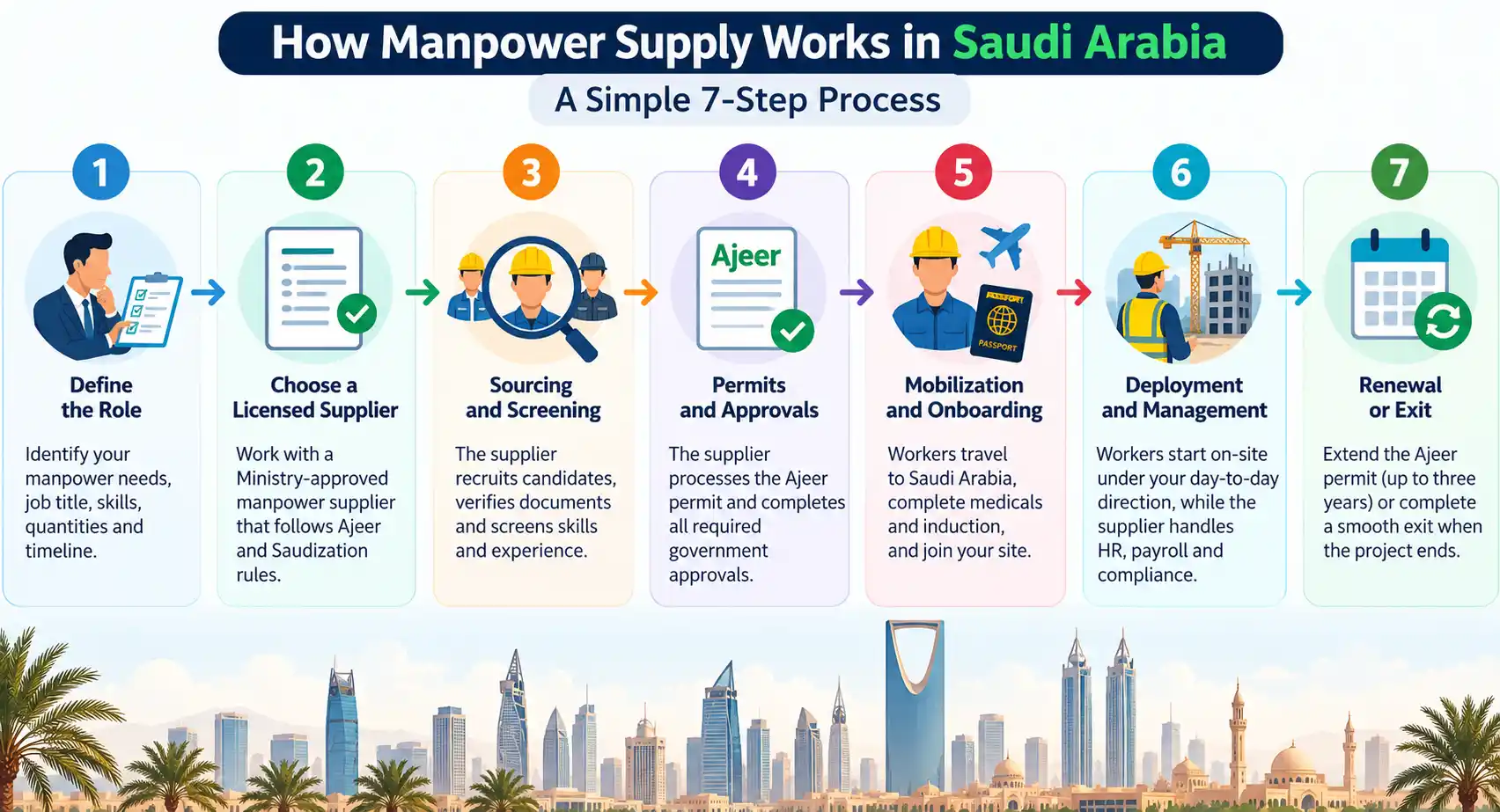
How Manpower Supply Works, Step by Step
A well-run placement follows the same sequence whatever the trade.
Step 1: Define the Role and Check Saudization
Write down the job title, the number of workers, the site and the start window. Then check the title against the current Saudization decisions, because a restricted role changes the whole plan.
Step 2: Choose the Contract Model
Decide whether you’re buying a service or renting labour. If you want a result, such as a cleaned building, service outsourcing fits. If you want people working under your direction, you’re in labour outsourcing and Ajeer applies.
Step 3: Shortlist, Test and Interview
Ask the supplier for CVs, trade test results and certificates. Interview candidates yourself where the role matters, and run a practical test for skilled trades.
Step 4: Complete Visas, Iqama, Insurance and Registration
As the legal employer, the supplier arranges the work visa and residence permit (Iqama) for workers coming from abroad. It also registers staff with the General Organization for Social Insurance (GOSI), buys the required medical insurance and documents the employment contract. If you handle part of this yourself, ProNexa’s visa consultancy covers visa processing for the KSA and the UAE, and its corporate services team manages Qiwa, Muqeem and Jawazat portals, Iqama renewals and GOSI compliance. Ask for proof at each stage.
Step 5: Issue the Ajeer Contract and Permit
Before any worker starts at your site, the supplier and your company sign the electronic contract, and the platform issues the permit. Keep a copy for every worker on site.
Step 6: Deploy, Supervise and Review
Give each worker a site induction and a task list that matches the profession on their labour card. Review performance with the supplier on a fixed schedule.
Step 7: Replace, Renew or End
Agree in writing what happens if a worker underperforms, resigns or becomes unavailable. Note the permit expiry date too, because staying past it counts as a violation.
Labor Law Basics for Employers of Outsourced Workers
Even when the supplier is the legal employer, these rules shape your cost and your risk. The points below come from published summaries of the Labor Law as amended in February 2025.
Written Contracts and Probation
Employers must issue written contracts to expatriate workers, and probation can’t exceed 180 days in total. If a contract ends during probation, neither side owes compensation and no end-of-service award is due.
Wages
Every private-sector employer must pay wages through the Wage Protection System and file payroll on the Mudad platform, which the ministry runs for that purpose. Ask your supplier to show proof of wage payment each month.
Annual Leave
Workers receive at least 21 days of paid annual leave, rising to 30 days after five consecutive years with the same employer.
End-of-Service Award
The award equals half a month’s wage for each of the first five years and one month’s wage for each year after that, based on the last wage. A worker who resigns gets one-third of the award after two to five years, two-thirds after five to ten years and the full award after ten years. Qiwa runs a free calculator.
Health Insurance
Private-sector employers must provide cooperative health insurance for their Saudi and non-Saudi employees, and the employer carries the cost, including cover for family members the system names (a spouse, sons up to age 25 and unmarried daughters). Residence permits have been linked to valid medical insurance, so a lapse can block an Iqama issue or renewal. The Council of Cooperative Health Insurance publishes the rules.
Working Hours
The law caps daily and weekly hours and reduces them during Ramadan for Muslim employees. Confirm the current limits with the ministry, because the Labor Law changed in February 2025.
Disputes
Workers have one year from the end of their contract to file a claim with the Commission for Settlement of Labour Disputes. Keep attendance logs, warnings and performance records, since you’ll need them if a case starts.
Manpower Services Cost in Saudi Arabia
Any article that prints one monthly rate for a technician in Saudi Arabia is guessing. Prices depend on the trade, the worker’s experience and origin, the contract length and what the rate includes. This section shows what makes up the bill so you can compare quotes properly.
What Makes Up the Cost
| Cost component | What it covers | What to check |
|---|---|---|
| Wages and allowances | Basic pay plus housing, transport or food where the contract provides them | Whether allowances sit inside the quoted rate |
| Government fees | Work visa, Iqama and Ajeer permit charges where they apply | Fees change, so ask which ones the supplier includes |
| Social insurance | GOSI contributions for each worker | Current rates on the GOSI website |
| Medical insurance | Compulsory cooperative health cover | Policy level and who pays |
| Accommodation, transport and flights | Housing, daily transport and travel as the contract agrees | Who provides each item and for how long |
| End-of-service accrual | The award a worker earns over time | Whether the supplier accrues it or bills it later |
| Supplier fee | Recruitment, payroll, compliance and replacement support | What the fee includes and excludes |
Common Pricing Models
Four models cover most quotes. A monthly rate per worker suits long placements. An hourly or daily rate suits rental and short projects, and it matches how labour outsourcing links payment to hours or labour rates. Cost-plus billing passes through the real costs and adds a fixed fee. A fixed fee tied to deliverables fits service outsourcing, where you pay for results.
Manpower Supplier vs Direct Hiring
| Factor | Direct hiring | Manpower supplier |
|---|---|---|
| Legal employer | You | The supplier |
| Admin workload | You handle visas, insurance, payroll and end-of-service | The supplier handles employer admin, and you manage the site work |
| Flexibility | Ending a contract triggers your own obligations | Scaling down follows the supplier contract and the Ajeer permit term |
| Cost visibility | You see each cost line directly | You see one rate, so ask what it includes |
| Compliance risk | You carry it fully | Shared between the supplier as employer and you as receiving company |
Why Two Quotes for the Same Trade Differ
Quotes differ because the inclusions differ. One supplier counts accommodation and transport in the rate, another bills them separately. One includes replacement cover, another charges for it. One assumes standard hours, another prices overtime up front. Line the quotes up against the cost table above before you compare totals.
Questions to Ask Before You Accept a Quote
- Which costs does the rate include, and which come on top?
- Who pays for accommodation, transport and flights?
- How does the supplier price overtime?
- What happens to the rate if the Ajeer permit or contract changes?
- What does the replacement guarantee cover, and for how long?
How to Choose a Manpower Services Provider in Saudi Arabia
A good supplier makes compliance easier. A weak one leaves you answering for its shortcuts. If you’re searching for the best manpower company in Saudi Arabia, rankings help less than these six checks.
Does the Supplier Hold the Right Licence?
Ask to see the MHRSD licence for labour outsourcing, and confirm it with the ministry. Don’t accept a commercial registration alone as proof.
Will It Issue an Ajeer Contract and Permit for Every Worker?
A compliant supplier says yes without hesitation and explains the process. If it talks about informal arrangements, walk away.
Is the Contract Written and Specific?
Insist on a written contract that names the profession, the site, the term, the rate and what the rate covers. Vague contracts leave you exposed when a worker’s role drifts away from the labour card.
How Does It Handle Replacement?
Ask for written terms on replacement time, who covers the gap and what triggers a replacement.
Does It Talk Honestly About Saudization?
A supplier that flags restricted job titles before you ask is protecting you. One that offers any role you request without comment isn’t.
Can It Show References From Your Sector?
Ask for two or three clients in your industry, and call them. Hospitality, construction and healthcare each make different demands.
Red Flags to Watch For
Be wary of a supplier that can’t show a licence on request, promises exact arrival dates before approvals exist, refuses to put terms in writing, or goes vague about who pays for insurance and social insurance contributions.
Manpower Services by City: Riyadh, Jeddah, Dammam and Jubail
Demand follows the economy of each city, and suppliers often specialise by region.
Riyadh
Riyadh drives demand from head offices, government-linked work, hospitality and large development projects such as ROSHN and Diriyah. ProNexa’s head office sits in Diriyah, and itscorporate services team handles government liaison and operational support for clients.
Jeddah
Jeddah’s Red Sea port, hotels and retail sector keep demand steady for hospitality staff, logistics support and facility technicians.
Dammam and Khobar
The Eastern Province is a hub for oil and gas and industrial contractors. Employers there often need mechanical, electrical and maintenance technicians, and their projects often move heavy equipment and materials too. ProNexa’slogistics and transport service covers heavy equipment and material transportation.
Jubail
Jubail Industrial City hosts heavy industry, so demand skews toward plant maintenance and industrial trades.
Starting a Business in Saudi Arabia? Sort These Steps Before You Hire
New companies can use manpower services, but the order matters. You need a commercial registration first, because the outsourcing rules apply to commercially registered companies. Foreign investors register with the Ministry of Investment (MISA) before they can apply for a commercial registration.
If you’re still at the formation stage, ProNexa’s business setup guide walks through the steps, its MISA licence guide covers investor registration, and its business incorporation service handles company formation and licensing.
Your establishment file and social insurance registration come next. Only then do visas, work permits and Ajeer contracts make sense. Skip ahead and your supplier can’t file your paperwork.
Accounting matters from week one. Payroll, VAT and Zakat all depend on clean records, and ZATCA expects them. ProNexa’s financial services team covers bookkeeping, ZATCA tax and VAT compliance and audit support. Once you’re registered, a company website and brand identity help you win clients, and ProNexa’s branding and marketing service covers both.
Manpower Terms Explained
| Term | Meaning |
|---|---|
| Ajeer | The ministry’s electronic platform for documenting outsourcing and issuing permits for outsourced workers. |
| Qiwa | The ministry’s labour-market platform for contracts, work permits and employer services. |
| Musad | The platform employers use to file wages under the Wage Protection System. |
| Muqeem | The Ministry of Interior service for managing residence permits and visas of expatriate employees. |
| GOSI | The General Organization for Social Insurance, which collects social insurance contributions for workers. |
| Nitaqat | The Saudization programme that rates companies by the share of Saudi staff they employ. |
| Iqama | The residence permit for expatriate workers. |
| WPS | The Wage Protection System, which tracks wage payments to workers. |
| EOSB | End-of-service benefit, the award a worker earns for completed service. |
| MHRSD | The Ministry of Human Resources and Social Development. |
| SCE | The Saudi Council of Engineers, which accredits engineers. |
| SCFHS | The Saudi Commission for Health Specialties, which registers and classifies health practitioners. |
| CCHI | The Council of Cooperative Health Insurance, which oversees compulsory health insurance. |
| Jawazat | The General Directorate of Passports, which handles residency and travel documents. |
| Hadaf | The Human Resources Development Fund, which supports recruiting and training Saudi staff. |
| MISA | The Ministry of Investment, where foreign investors register before they apply for commercial registration. |
| ZATCA | The Zakat, Tax and Customs Authority, which manages tax, VAT, Zakat and customs. |
Why Businesses Choose ProNexa for Manpower
ProNexa supplies managers and engineers, technicians, supervisors, equipment operators and general labour, with project support staff where the Saudization rules allow, through its corporate manpower solutions service. The same company also handles visa consultancy, business setup and business incorporation, corporate services such as GRO and compliance operations, financial services, construction services, general trading and logistics and transport. You can deal with one company for setup, visas, compliance support and workers, instead of coordinating several.
Ready to talk through your staffing plan? Request a quote through ProNexa’s contact page, or read more about ProNexa.
Frequently Asked Questions About Manpower Services in Saudi Arabia
What are manpower services in Saudi Arabia?
Manpower services in Saudi Arabia are arrangements where a licensed company recruits, employs or supplies workers for another business. Depending on the model, you either hire screened workers yourself, or the supplier stays their legal employer while they follow your direction on site. The three common models are recruitment, service outsourcing and labour outsourcing.
Is manpower supply legal in Saudi Arabia?
Yes, manpower supply is legal in Saudi Arabia when it follows the Labor Law and the outsourcing rules that took effect in January 2026. Placing non-Saudi workers at another company’s site must go through the Ajeer platform, with a permit for each worker. Advisory firms also report that the supplier needs the right MHRSD licence, so ask to see it.
What is the Ajeer platform?
Ajeer is the Ministry of Human Resources and Social Development’s electronic platform for documenting outsourcing between establishments. Suppliers and receiving companies sign contracts on it, and it issues a permit for each outsourced worker. The permit acts as proof that the worker is lawfully present at the receiving company’s premises.
How long does an Ajeer permit last?
An Ajeer permit lasts for a maximum of three years. If the service contract ends earlier, the permit ends with it. Each arrangement with a different company needs its own Ajeer application.
What is the difference between service outsourcing and labour outsourcing?
Service outsourcing means the supplier delivers a defined service with its own staff and management, while labour outsourcing places a non-Saudi worker at your site under your supervision. Payment in service outsourcing follows agreed results. Payment in labour outsourcing follows hours worked or labour rates, and the arrangement runs through Ajeer.
Who pays the workers’ wages in manpower outsourcing?
The supplier pays the workers’ wages because it stays their legal employer, and you pay the supplier under your contract. Wages must run through the Wage Protection System. Check that your contract says which costs, such as accommodation, transport and insurance, sit inside the supplier’s rate.
Which jobs can’t expatriates hold in Saudi Arabia in 2026?
Sixty-nine administrative support professions are reserved for Saudi nationals under Ministerial Decision 132249. They include storekeeper, secretary, human resources clerk, data entry operator, cashier, receptionist, records clerk, shipping clerk and administrative assistant. Nineteen applied from 5 April 2026 and the other fifty from 4 October 2026, and the list may grow, so check the current ministry schedule.
What are the Saudization rates for engineers and procurement staff?
Engineering professions carry a 30% Saudization rate and procurement professions carry 70%. The engineering rule covers 46 professions and applies to establishments with five or more workers in those roles. The procurement rule covers 12 professions and applies to establishments with three or more.
Can a new company in Saudi Arabia use manpower services?
Yes, a new company can use manpower services once it has a commercial registration, because the outsourcing rules apply to commercially registered companies. Sorting out your registration and licences first avoids delays when the supplier files your Ajeer contract. A foreign-owned company should also confirm its MISA investment registration before it hires.
How long does it take to get workers in Saudi Arabia?
The timeline depends on the trade, the worker’s country, visa processing and your approvals, so no honest supplier can promise one fixed number. Workers already inside the Kingdom can usually start sooner than workers who need a new visa. Ask for a written estimate that lists each step and who controls it.
What happens if a worker stays after the Ajeer permit expires?
The receiving company commits a violation from the first working day after the permit expires. The rules also require you to return the worker to the supplier within one working day once the permit is revoked. Penalties follow under the applicable regulations, so renew or end the arrangement before the permit date.
How can I check that a manpower supplier is licensed?
Ask the supplier to show its MHRSD licence for labour outsourcing, then confirm it with the ministry. A compliant supplier will also issue an electronic Ajeer contract and permit for every worker before work starts. If a supplier avoids either request, treat that as a reason to walk away.
What is the difference between manpower supply and a recruitment agency in Saudi Arabia?
A recruitment agency finds candidates and you become their employer, while a manpower supplier keeps the workers on its own payroll and places them at your site. Recruitment usually ends with a one-time placement fee. Manpower supply continues for the whole assignment and runs through Ajeer when non-Saudi workers join your premises.
What is project-based manpower?
Project-based manpower is a team of workers supplied for a defined project, such as a fit-out, a maintenance shutdown or an opening, and released when the work ends. The contract names the trades, headcount, site and duration. Under the 2026 rules, one Ajeer permit can’t cover an arrangement for more than three years.
Is there a minimum contract period for manpower supply in Saudi Arabia?
The contract between you and the supplier sets the contract period, and suppliers often set minimum terms for skilled trades. An Ajeer permit caps an arrangement at three years. Ask for the minimum term, the notice period and the early-exit terms in writing before you sign.
What does a replacement guarantee cover in manpower supply?
A replacement guarantee is the supplier’s written promise to replace a worker who leaves, underperforms or becomes unavailable. The terms differ by supplier, so check the replacement time, who covers the gap and which reasons qualify. Put those terms in the contract, because a verbal promise won’t protect you.
What is the difference between an Employer of Record and manpower outsourcing in Saudi Arabia?
An Employer of Record employs workers on your behalf so you can direct their work without setting up your own entity, while manpower outsourcing places workers employed by a supplier at your site. Providers use both labels loosely. Check which licence and contract structure sits behind the label, and remember that placing workers under another company’s supervision runs through Ajeer.
How can a company hire foreign workers in Saudi Arabia?
A company can hire foreign workers directly as their employer, or through a licensed supplier that stays their legal employer. Direct hiring needs a commercial registration, workforce registrations, work visas and Iqamas, and compliance with Saudization rules. A supplier takes over the employer paperwork, and Ajeer covers the placement at your site.
Is manpower outsourcing cheaper than direct hiring in Saudi Arabia?
Manpower outsourcing isn’t automatically cheaper than direct hiring, because the answer depends on the trade, the contract length and what the supplier’s rate includes. Direct hiring puts visas, insurance, payroll and end-of-service costs on you. Outsourcing bundles them into one rate, so compare quotes line by line before you decide.
What is manpower outsourcing in Saudi Arabia?
Manpower outsourcing is an arrangement where a licensed supplier employs workers and places them with your business, or delivers a service with its own staff, instead of you hiring directly. The supplier stays the legal employer and handles contracts, work permits and payroll. For non-Saudi workers placed at your site, the arrangement runs through the Ajeer platform.
Am I legally responsible for outsourced workers in Saudi Arabia?
The supplier stays the legal employer, but you still carry duties as the receiving company. You must not start work before the Ajeer permit exists, must keep workers in the profession on their labour card, and must not keep them on site after the permit ends. Your contract should also say who covers wages, insurance and end-of-service costs.
Can I interview workers before a manpower supplier sends them?
Yes, you can usually interview shortlisted workers and run trade tests before you approve them, and a good supplier arranges this as a normal step. Put the screening steps and your right to reject a candidate in the contract. For skilled trades, a practical test tells you more than a CV.